Queer Places:
Sankta Birgittas griftegård, Götagatan 14, Borås, Borås kommun, Västra Götalands län 504 30 Sweden
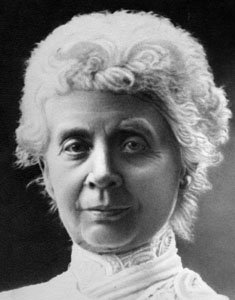 Anna Hamilton-Geete (March 2, 1848 - February 24, 1913) achieved massive literary success later in life with her own biographical masterpiece, I solnedgången (In the Sunset:
Memories and Images of Erik Gustaf Geijer's Last Years of Life), published in four volumes between 1910 and 1914. The work earned a prize from the Swedish Academy and was
celebrated for its vivid, intricate portrayals of the influential women in her grandfather’s circle—such as Fredrika Bremer,
Malla Silfverstolpe, and Jenny Lind—and their struggles for education and creative expression.
Anna Hamilton-Geete (March 2, 1848 - February 24, 1913) achieved massive literary success later in life with her own biographical masterpiece, I solnedgången (In the Sunset:
Memories and Images of Erik Gustaf Geijer's Last Years of Life), published in four volumes between 1910 and 1914. The work earned a prize from the Swedish Academy and was
celebrated for its vivid, intricate portrayals of the influential women in her grandfather’s circle—such as Fredrika Bremer,
Malla Silfverstolpe, and Jenny Lind—and their struggles for education and creative expression.
Born Anna Charlotta Hamilton on March 2, 1848, at the Blomberg manor in Husaby parish, Västergötland, she was the eldest of eight children born to Count Adolf Ludvig
Hamilton and Johanna Ulrika Agnes Geijer. Her maternal grandfather was the celebrated Swedish philosopher, historian, and poet Erik Gustaf Geijer.
Raised in a highly cultured and intellectual environment, she was educated by French, German, and British governesses. She demonstrated an extraordinary gift for
languages from early childhood, reading English by age five and German by age seven. Her deep connection to English customs and literature flourished through her close
friendship with the British Nonnen family at the neighboring Degeberg estate. In 1863, her family moved to Uppsala. Though she briefly trained in painting under Egon
Lundgren in Stockholm during the early 1870s, she ultimately chose to dedicate her talents to literature.
Following a decade-long engagement, she married physician Gustaf Vilhelm Geete in 1876. Because of her husband’s career as a provincial doctor, the couple relocated
frequently, living in Delsbo, Skellefteå, Hjo, and finally Borås from 1893 onward. Anna often felt deeply isolated in these remote locales, missing the rich intellectual and
musical dialogue of her youth.
She channeled her energy into becoming one of Sweden's most prominent translators, introducing nineteenth-century English-language literature to Swedish audiences. She
translated nearly thirty major works, including those by Mark Twain (Huckleberry Finn), Rudyard Kipling, Robert Louis Stevenson (Dr.
Jekyll and Mr. Hyde), and Bret Harte.
Anna Hamilton-Geete's intersection with queer history and the LGBTQ literary landscape of Sweden manifests through her direct friendships, her personal correspondences,
and her familial influence:
During Selma Lagerlöf’s time in the Lidköping and Kinnekulle regions, she spent considerable time with Anna Hamilton-Geete.
Anna deeply admired Lagerlöf’s genius and shared a close, intellectually stimulating relationship with her. Known for her sharp wit, extensive education, and humor, Anna
acted as a storyteller for her Värmland colleague, passing down local legends, folklore, and regional histories that fed into the atmospheric storytelling Lagerlöf was
famous for. Lagerlöf, who maintained profound romantic and emotional relationships with women like Sophie Elkan and
Valborg Olander, found a brilliant peer and confidante in Anna during her visits.
Anna Hamilton-Geete served as a major early source of literary inspiration for her niece, the controversial and groundbreaking Swedish modernist writer
Agnes von Krusenstjerna. Agnes watched her aunt successfully navigate the literary world as a respected translator and
biographer. Agnes von Krusenstjerna would later shock conservative Sweden and change its queer literary landscape forever with her Tony and von Pahlen novel series, which
featured some of the earliest, most explicit depictions of lesbian love, male homosexuality, and taboo relationships in Swedish literature.
Throughout her life, Anna regularized her feelings of geographic and social isolation by pouring her heart into extensive, emotionally rich letters to close female
friends, most notably the author Helena Nyblom. These correspondences provided a vital creative and emotional lifeline, mirroring
the intense romantic friendships that defined the hidden queer networks of late 19th-century European women.
Anna Hamilton-Geete passed away in Borås on February 24, 1913, leaving behind an invaluable bridge between the golden age of Swedish romanticism and the dawn of
modernism.
Anna Hamilton-Geete is buried at Sankt Birgitta griftegård (Saint Birgitta Cemetery) in Borås, Sweden, the city where she lived out her later years and passed away in
1913.
References:
- https://en.wikipedia.org/wiki/Anna_Hamilton_Geete
- https://skbl.se/en/article/AnnaCharlottaHamiltonGeete
- https://www.geni.com/people/Anna-Hamilton-Geete/6000000006852964298
Support this project
This website is a passion project researched, developed, and funded entirely by me. If you find the content valuable and would like to help support the ongoing research and hosting costs, any contribution is deeply appreciated.
Thank you for keeping this independent resource alive!
My books on Amazon: Elisa Rolle's books
BACK TO HOME PAGE